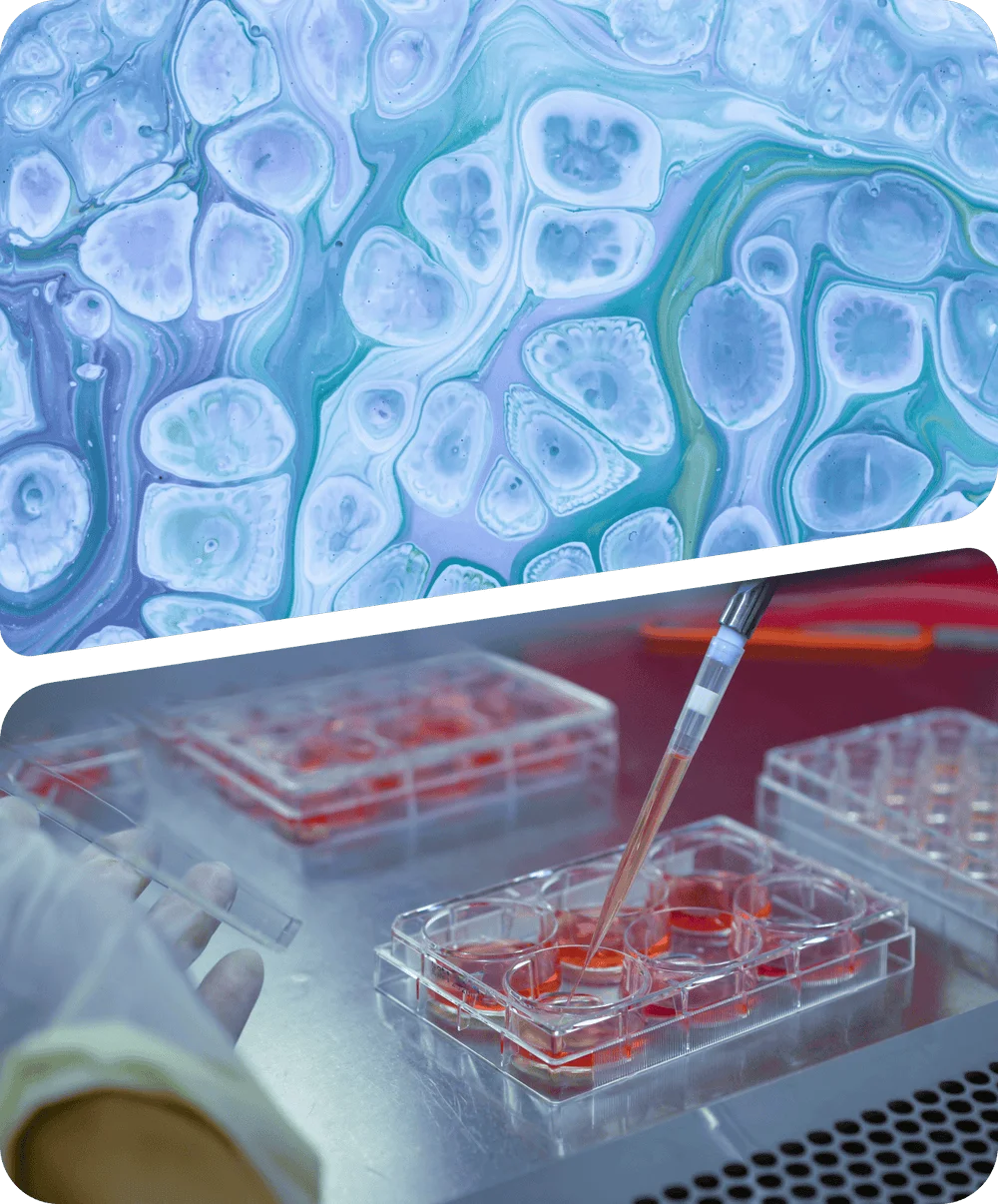


Viable cell lines (immortalized, consistent) and explant models (fresh tissue pieces, complex microenvironment) are crucial ex vivo research tools, offering complementary advantages: cell lines are versatile for large-scale studies, while patient-derived explants (PDEs) better mimic tumor/tissue complexity, preserving cellular diversity and stromal interactions for more physiologically relevant drug testing and disease modeling, though with shorter culture life than cell lines.
Viable Cell Lines (e.g., HeLa, HEK293, Cancer Cell Lines)
Definition:
Cultured cells that have acquired the ability to divide indefinitely (immortalized) or are derived from primary tissues but adapted for long-term growth.
Pros:
Easy to maintain, scalable, cost-effective, consistent, good for high-throughput screening (HTS).
Cons:
Often lose original tissue heterogeneity and complex interactions, can accumulate genetic aberrations, less physiologically relevant than primary models.
Types:
Finite (limited divisions), Continuous/Immortalized (indefinite), Stem Cell lines.
Explant Models (Patient-Derived Explants - PDEs)
Definition:
Fresh, small pieces of surgically removed tissue (e.g., tumor, organ biopsy) maintained in culture, preserving the original 3D structure and microenvironment.
Pros:
Maintain cellular heterogeneity (cancer cells, stroma), preserve 3D architecture, better reflect in vivo conditions, valuable for drug testing on whole tissue.
Cons:
Shorter culture lifespan, more difficult to establish, less amenable to standard HTS, can have variability.
Applications:
Studying cancer heterogeneity, bone/cartilage metabolism, drug response in complex settings, understanding cell-matrix interactions.
For more details, contact our team at bd@cell-bio.life